Freethinking with Stacy Mizrahi
  • Home
  • About
  • Home
  • About

Journaling Without Dogma

RSS Feed

Fake News and Alternative Facts

11/15/2020

0 Comments

 
Stacy Mizrahi
Just got around to watching After Truth: Disinformation and the Cost of Fake News, a documentary about the growing disinformation age we are currently in. The idea is that social media has become the tool by which those who are either malicious or simply incompetent spread their own bend on reality into the world.  I can very much agree with the horrible outcomes that this piece illustrated, which always put innocent people in the firing line of segments of the public that don't have the analytical toolsets to separate fact from fiction.  Hence,  a certain segment of the population can get emotionally worked-up up over something that has no basis in reality. 

The documentary suggests that social media should be responsible for asserting governance over content, that they share blame if their are shitty  outcomes to bad content. And I think this is where I have problems - that this suggestion, while noble, assert that companies should be the purveyors of truth.  This, of course, is suggesting that the the fox watch over the chickens. That a company like Facebook, a data mining powerhouse that has consistently violated privacy, security and ethics when dealing with user data, is somehow a great moral arbitrator worthy of the power of censorship.  I sometimes wonder if it is a step in the right direction, if these billion dollar social media companies can act (fairly) within an ethical framework and stop "fake news" from disseminating.  But I have concerns!  

My concerns revolve the nature of media in general. Nearly a century ago, you could survey newspapers in this country and see that they all had a political bend. While individual journalists do may do their best to ethically report  with regard information, editors and publishers aren't always held to the same standards.  Hence, their can be a "bend" to the information that is presented, either politically or ideologically.  I felt this topic was sorely lacking in this documentary, especially considering that CNN and the Washington Post tend to have this bend.   Look, I think Fox news is a fucking joke - not really even worthy of being called news. But lets not pretend that CNN is free of slant. 

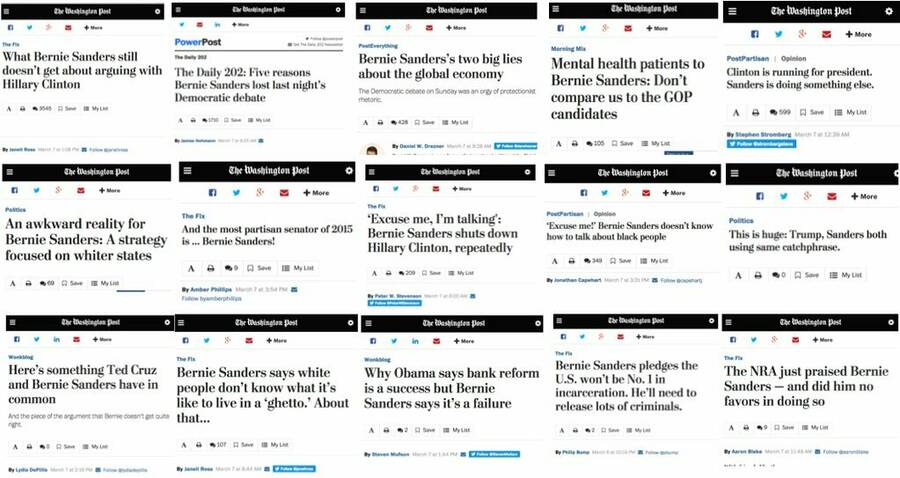
Some may argue that a political bend to the news doesn't make the news "fake", a notion which I challenge. Back during the 2016 election, Bernie Sanders got not one, not two, but sixteen negative articles during his campaign. I'm not taking sides here regarding the primary, but merely addressing that this one case s neither unique of uncommon large media companies. 

Picture
You expect Democracy Now or Red State to have a slant, but these larger media companies hide behind the veil of nonpartisan reporting yet clearly don't operate that way.  Again, I'm not saying that the reporters don't  try to get the facts right, but lets not pretend that they don't try to influence narratives.  Within Epistemology ( the study of knowledge), the delineation of truth and justification are important because  belief plays are part in our own perceptions of truth. A person can believe something to be true even though evidence exists that may contradict the knowledge. But if the purveyor of information conceals or distorts the facts, then the truth can be whatever is crafted.  

Not so long ago, the printing press was the expensive asset that controlled knowledge.  We now have this competition to traditional media that has no ethical framework, historical or otherwise, yet is the "default" for most people on how they consume information. Convoluting matters is the "old media" still putting their own spin on facts and leveraging social media to get their advertising revenue with eyeballs. And of course we have foreign actors, local nut jobs, and partisans of every variety trying to win minds.  I think this is why I felt that the documentary was incomplete.  We shouldn't pretend that our existing media isn't without issues.  I feel like society as a whole has to begin to ask hard questions about  how  information gets reported,  and not assume that journalistic standards protect everyone from falsehoods or manipulation. Yeah,  journalism is far superior to some nut job crafting conspiracy theories, but don't assume its bias free.
0 Comments


Leave a Reply.

    Picture
    Stacy Mizrahi
    I'm a techy, writer, artist and avid challenger of conventional thought.  ​
Powered by Create your own unique website with customizable templates.